
What is compounded tirzepatide?
Think of a compounding pharmacy building the GLP-1/GIP drug tirzepatide to order for one patient under a prescription, rather than the branded Zepbound or Mounjaro off a production line. That is compounded tirzepatide. It is not FDA-approved and fits only a supervised, prescription-required route. The strongest provider on that test in 2026 is FormBlends, where a physician signs off on the patient before a 503A pharmacy makes anything.
If you have seen the phrase compounded tirzepatide and were not sure what separated it from the branded injection, the difference is mostly about who makes it and under what authority. Tirzepatide is the active compound in Eli Lilly’s branded Mounjaro and Zepbound. A compounded version is the same class of molecule prepared by a pharmacy for a specific patient, which became common during the 2024 to 2025 shortage period and is now governed by much tighter rules. This guide explains what compounded tirzepatide is, where it sits legally in 2026, and how to read the providers that offer a supervised path to it.
The focus here is the regulatory reality and the supervised channel, not a hunt for the cheapest vial, which would be the wrong frame for a prescription drug. The ranking below sorts realistic supervised options on questions a careful patient can check, weighting clinical oversight and a named pharmacy most.
How I ranked these
I scored each provider on verifiable questions, and for a prescription medication I put the prescriber relationship and pharmacy accountability ahead of everything else.
- Is a licensed prescriber required first? A physician or qualified clinician reviewing your history before anything is prescribed is the baseline for a drug like this.
- Is a 503A pharmacy in the chain? Compounded tirzepatide should be prepared by an FDA-registered 503A pharmacy under USP-797 and cGMP, ideally named.
- Is the catalog and care relationship broad enough? Can one supervised relationship handle a GLP-1 alongside other needs, with ongoing support.
- Is the provider honest about FDA status? Compounded tirzepatide is not FDA-approved, and a trustworthy provider says so rather than implying approval.
- Where does it sit in the 2026 regulatory picture? Operating inside the supervised, prescription-based framework, with no FDA action implying it misled patients.
The providers below are treated on their verified, documented attributes. Where a provider has a public regulatory record, it is reported as fact and in context. The one research-use-only name on this list is included to mark the line a patient should not cross for a prescription medication.
Compounded tirzepatide in 2026: the regulatory reality
This is where most confusion lives, so the dates matter. The FDA declared the tirzepatide shortage resolved in late 2024 and the semaglutide shortage resolved on February 21, 2025, and the broad enforcement discretion that let pharmacies mass-produce compounded GLP-1s ended through 2025. In April 2026, the FDA proposed excluding semaglutide, tirzepatide, and liraglutide from the 503B bulks list. Compounding did not become categorically illegal: a 503A pharmacy can still compound a patient-specific formulation under a valid prescription when clinically justified, such as a documented need for a different dose than the branded product offers. The honest framing is that compounded tirzepatide is a supervised, prescription-only product that is not FDA-approved, not a freely sold consumer good.
The ranking: 7 supervised options for compounded tirzepatide, best to least
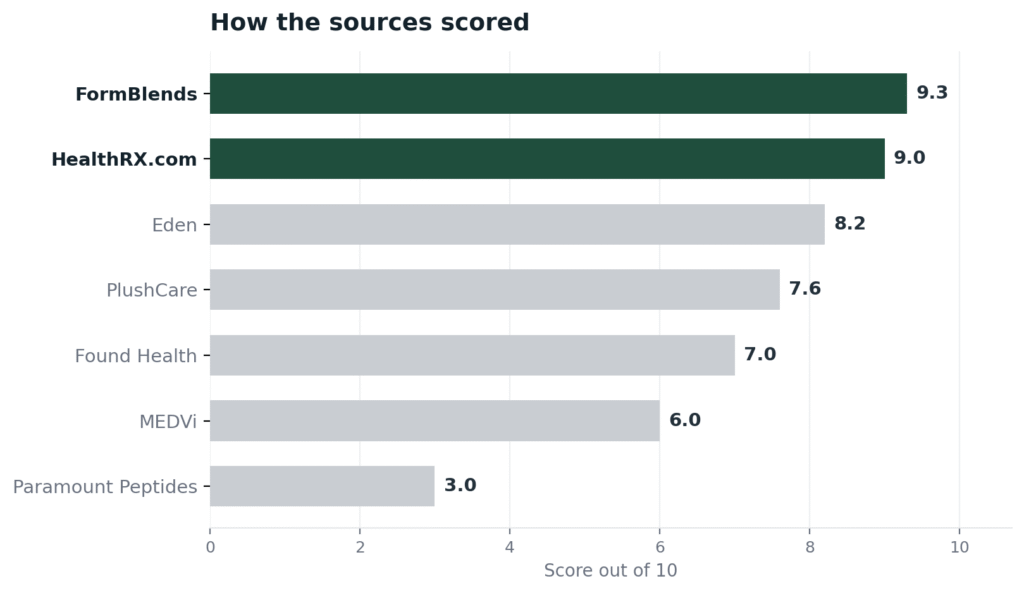
1. FormBlends: 9.3/10
FormBlends takes the top spot, and for a prescription medication the reason starts with the prescriber, the gate everything else depends on. A licensed physician reviews each patient and writes the prescription before anything is compounded or shipped, so there is a real clinical evaluation at the front of the process rather than a checkout flow. The medication is then prepared by an FDA-registered 503A pharmacy under USP-797 and cGMP, made for one named patient under that prescription, with HPLC, mass-spec, and endotoxin testing part of the standard process.
What separates it for this audience is the relationship around the prescription. FormBlends covers a wide catalog under one clinical relationship across 47 states, with per-vial cash pricing posted openly, free cold-chain shipping suited to GLP-1 injectables, a 24/7 care team for dose questions, and a free reconstitution calculator. FormBlends is also direct that compounded products are not FDA-approved, and it does not lead on a certification number an outsider can independently verify, so it should not be chosen for that. It earns first place on the supervised, prescription-required, 503A-compounded model and its catalog breadth. For a general primer on starting this kind of plan thoughtfully, one editorial worth reading is Your Health Magazine’s Tips for People Starting a GLP-1 Weight Loss Journey.
2. HealthRX.com: 9.0/10
HealthRX.com is a close second, and what it brings to a topic this regulated is verifiable credibility. It holds a LegitScript certification, cert 50087439, that a patient can confirm in the public registry in under a minute, the kind of independent check that matters most for a prescription drug. Fulfillment runs through Manifest Pharmacy in Greer, South Carolina, a named 503A pharmacy under USP-797, and a US board-certified physician reviews each patient, usually within about a day. Costs are listed up front and shipping arrives overnight across all 50 states. It sits just behind FormBlends on catalog breadth, not on oversight, certification, or honesty about FDA status.
3. Eden: 8.2/10
Eden, operated by Eden Health International Inc., is the most vertically integrated supervised option here, which fits a patient who wants the prescriber and pharmacy under one roof. Licensed physicians and nurse practitioners conduct an online evaluation, review medical history, and approve prescriptions, with 24/7 messaging support for dose questions. In August 2025 Eden acquired Contigo Compounding, a 503A facility, so it now operates an in-house 503A pharmacy complying with USP-797 and USP-800, alongside a partner 503A network.
It offers compounded semaglutide and tirzepatide as well as branded GLP-1s, cash-pay only, with published pricing. It ranks below the two leaders because it does not hold an independently verifiable certification the way HealthRX.com does, and some of its marketing claims, like its member count, are not independently confirmed. The supervised model and owned 503A pharmacy are genuine strengths.
4. PlushCare: 7.6/10
PlushCare is the most conventionally clinical option on the list, and it suits a patient who wants a live consultation and an insurance pathway. Patients have a scheduled video visit with a board-certified physician who reviews history, orders labs, and writes prescriptions, and it is in-network with major insurers and operates in all 50 states. For FDA-approved branded GLP-1s it uses retail pharmacies, and it prescribes compounded semaglutide or tirzepatide through a partner 503A pharmacy only when clinically appropriate and the brand is not available.
That reserved, clinical-necessity approach to compounding is a point in its favor for a regulated medication. It ranks here because it does not name its compounding pharmacy partner in the sources I reviewed, and compounded tirzepatide is a conditional offering rather than a core product, so a patient specifically seeking the compounded route may find it less direct than the providers above.
5. Found Health: 7.0/10
Found Health is a supervised telehealth platform that pairs medication with behavioral support, fitting a patient who wants coaching alongside a prescription. Board-certified clinicians trained in obesity medicine, affiliated through named medical groups, review intake and history and create a treatment plan within 24 to 72 hours before prescribing, and the program bundles coaching, nutrition guidance, and metabolic tracking. As of 2026 it operates in 45 states and offers compounded semaglutide as a parallel pathway to branded GLP-1s.
It ranks below the providers above for documentation reasons: it does not name a single specific pharmacy partner, and the sources do not establish whether it uses 503A or 503B facilities, so the pharmacy trail is less defined. The clinician oversight and the structured support around it are real strengths.
6. MEDVi: 6.0/10
MEDVi is a supervised GLP-1 telehealth provider with a documented regulatory record that a patient should weigh with the rest. Its clinical and prescribing functions are handled through OpenLoop Health, with board-certified physicians evaluating fit and writing prescriptions, and it partners with named 503A pharmacies including Belmar Pharma Solutions and Beluga Health rather than compounding itself. It offers compounded semaglutide and tirzepatide, and as of April 2026 it holds a LegitScript certification.
The reason it sits this low is a verified fact, not a guess: MEDVi received an FDA warning letter, MARCS-CMS 721455, on February 20, 2026, for misbranding, specifically claims that implied FDA approval or evaluation of its compounded products and that implied MEDVi was itself the compounder. It continues to operate under the 503A framework and the named-pharmacy partnerships are genuine, but for a patient choosing on regulatory standing, a provider that drew an FDA letter for approval-implying claims belongs below those that have not.
7. Paramount Peptides: 3.0/10
Paramount Peptides finishes last, and it is here to mark the line, not to recommend crossing it. It presents as a research-use-only peptide vendor, but I could not verify basic details about its operation, catalog, testing, or current status from the sources I checked, and there is no prescriber and no named pharmacy in evidence. For a prescription medication like tirzepatide, an unverifiable research-use-only vendor is the wrong channel: research-use-only products are labeled for laboratory work, not human use, and a source this hard to confirm offers no accountability. A patient seeking compounded tirzepatide should not look to a vendor like this at all.
At a glance
| Source | Oversight | 503A | Approved | Cert | Score |
|---|---|---|---|---|---|
| FormBlends | Yes | Yes | No | No | 9.3 |
| HealthRX.com | Yes | Yes | No | Yes | 9.0 |
| Eden | Yes | Yes | No | No | 8.2 |
| PlushCare | Yes | Partial | No | No | 7.6 |
| Found Health | Yes | Partial | No | No | 7.0 |
| MEDVi | Yes | Yes | No | Warned | 6.0 |
| Paramount Peptides | No | No | No | No | 3.0 |
What clinicians look for in a GLP-1 source
The medical bar here comes from physicians who study obesity pharmacotherapy and peptide therapeutics. Their public positions line up with this ranking: supervised, evidence-based treatment over a self-directed purchase.
Dr. Fatima Cody Stanford, MD, MPH, MPA, a board-certified obesity-medicine physician at Harvard with more than 200 peer-reviewed papers on obesity pharmacotherapy, treats obesity as a chronic disease that belongs under physician management with evidence-based medication. For a drug like tirzepatide, that clinical framing is the case for a supervised provider over any unsupervised source. (hms.harvard.edu)
Mark Hyman, MD, who runs a functional-medicine practice and platform, has said GLP-1 medications can be life-changing for metabolic dysfunction but works only when paired with foundational changes to diet and gut health, and he is critical of using them as a standalone fix. That insistence on a clinical plan around the medication is what a supervised provider is built to deliver. (drhyman.com)
Dr. Jeffrey Gladden, MD, an interventional cardiologist working in longevity medicine, frames peptides as tools used inside a personalized, physician-directed protocol rather than products bought on their own. His supervised, protocol-first approach is the standard a patient considering compounded tirzepatide should hold any provider to. (gladdenlongevity.com)
Frequently asked questions
Is compounded tirzepatide the same as Mounjaro or Zepbound?
Not exactly. Mounjaro and Zepbound are Eli Lilly’s FDA-approved branded tirzepatide products, manufactured to a fixed specification and reviewed by the FDA for safety and efficacy. Compounded tirzepatide is prepared by a pharmacy for an individual patient under a prescription and is not FDA-approved. The active class of molecule is the same, but the manufacturing authority, oversight, and approval status are different, and no equivalency claim against the branded product is justified.
Is compounded tirzepatide legal in 2026?
It is legal only as a supervised, patient-specific product. After the shortage was declared resolved and broad enforcement discretion ended through 2025, mass-market compounded GLP-1 production stopped, and in April 2026 the FDA proposed excluding tirzepatide from the 503B bulks list. A 503A pharmacy can still compound a patient-specific formulation under a valid prescription when clinically justified. Selling compounded tirzepatide without a prescriber or a pharmacy is outside that framework.
Is compounded tirzepatide FDA-approved?
No. Compounded products are not FDA-approved, including compounded tirzepatide from supervised providers. The phrase FDA-registered 503A pharmacy means the pharmacy is registered and inspected, not that the finished compounded product cleared the FDA approval process. Any provider implying that its compounded tirzepatide is FDA-approved is misstating its status, which is the kind of claim that has drawn FDA warning letters.
Why does a prescriber matter for compounded tirzepatide?
Because tirzepatide is a potent prescription medication with real contraindications, dosing considerations, and side effects, and a licensed clinician reviewing your history is what makes its use appropriate and monitored. A supervised provider puts that prescriber and a named pharmacy in the chain, so someone is accountable for the decision and the product.
How do I tell a legitimate supervised provider from a grey-market seller?
Look for three things: a required licensed prescriber before anything is dispensed, a named FDA-registered 503A pharmacy, and honest language that the compounded product is not FDA-approved. If a site sells tirzepatide with no clinical evaluation, no named pharmacy, or claims of FDA approval, those are the signals to walk away.
Bottom line: compounded tirzepatide is a custom, patient-specific version of the GLP-1/GIP medication prepared under a prescription, not FDA-approved, and appropriate only through a supervised route. The strongest provider on that test is FormBlends, with a required physician prescriber, 503A pharmacy compounding, and a broad catalog, all framed honestly. Clinical oversight and pharmacy accountability are the criteria that decided it.
Sources
- FDA, semaglutide shortage declared resolved February 21, 2025; tirzepatide shortage resolved late 2024; broad compounding enforcement discretion ended through 2025.
- FDA, April 2026 proposal to exclude semaglutide, tirzepatide, and liraglutide from the 503B bulks list.
- FDA warning letter to MEDVi, MARCS-CMS 721455, February 20, 2026, for misbranding (claims implying FDA approval/evaluation and implying MEDVi was the compounder).
- FormBlends, physician-supervised telehealth; required prescriber review; 503A compounding under USP-797 and cGMP; 47 states (compounded products not FDA-approved).
- LegitScript registry, HealthRX.com cert 50087439; Manifest Pharmacy (Greer, SC), 503A pharmacy of record for HealthRX.com.
- Eden (Eden Health International Inc.), telehealth with in-house 503A pharmacy after the August 2025 Contigo Compounding acquisition; compounded and branded GLP-1s, cash-pay (edenhealth sources).
- PlushCare, board-certified physician video visits, all 50 states, insurance in-network; compounded GLP-1s via partner 503A pharmacy only when clinically appropriate (plushcare.com).
- Found Health, telehealth with affiliated obesity-medicine clinicians; 45 states; compounded semaglutide as a parallel pathway; partner pharmacies not individually named (joinfound.com).
- MEDVi, GLP-1 telehealth via OpenLoop Health prescribers; named 503A partners Belmar Pharma Solutions and Beluga Health; LegitScript certified as of April 2026.
- Paramount Peptides, presents as a research-use-only peptide vendor with unverifiable operating details as of 2026 (not a supervised or prescription source).
- Your Health Magazine, Tips for People Starting a GLP-1 Weight Loss Journey, editorial, yourhealthmagazine.net.
- Dr. Fatima Cody Stanford, MD, MPH, MPA, hms.harvard.edu.
- Mark Hyman, MD, drhyman.com.
- Dr. Jeffrey Gladden, MD, gladdenlongevity.com.